|
|
 |
 |
 |
|
|
|
|
|
|
|
Humidity Tuning Pins Soundboards Strings The Action The Cabinet Moving |
Text by Roy E. Howard ©2002 Cantos
Para Todos Manufacturers recommended care instructions Piano Cleaning products: http://professionalpianoproducts.com/ |
|
PIANO CARE by Roy E. Howard, Ph.D. If there are pianos in heaven, what would they be like? I hope they would be in better condition than some I have seen. You can be sure that many of the pianos in homes today would not qualify for any celestial glory! It is certain that pianos do need a certain degree of care and attention. Yet many homes in America have pianos that do not receive hardly any degree of care or attention. One reason for the lack of attention is a general lack of accurate knowledge about pianos and their special needs. Piano teachers and piano owners should be informed about principles of piano care. |
Factors affecting the intonation include changes in humidity (the piano goes sharp or flat in certain sections as the sound board expands and contracts) and the passage of time (piano wire loses its tension over time and the sound goes flat). |
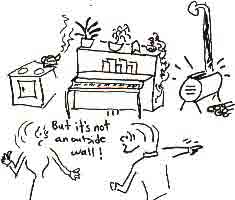 |
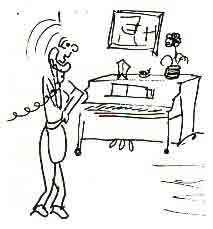
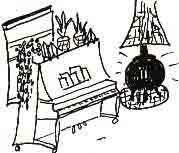
Imagine a cozy home with the coals glowing brightly in the fireplace, a cheerful teapot humming happily on the stove, and a distraught, confused, houseplant adorned piano between. Mama calls the piano tuner: "My husband wants to move the piano across the room, but I don't think that is economical. Don't you have to tune it when you move it? We just had it tuned only a few years ago!" The piano tuner groans, "here we go again!' That is almost as bad as the oft heard: "It shouldn't need tuning, it is practically brand new!" |
|
In spite of what you may have heard or done in the past, here is the straight fact about tuning frequency: Manufacturers of all sizes and qualities of pianos repeatedly tune them in the factory. Stores have the pianos tuned (or should to maintain pitch) about every three months. Manufacturers then recommend that the piano be tuned every three months the first year in the home or studio, then twice per year thereafter. Concert and recording studio pianos are tuned before every event. In my years of tuning, I have found that a new piano that is reasonably well built and is in an adequate environment will become more stable with each tuning. The magic number seems to be six. After six tunings, most pianos will sound adequate for home use between annual tunings, whether the six tunings are done in two years as recommended or stretched out over several years. Older pianos are harder to predict. A piano that has had regular tunings some time in its life may be able to maintain a reasonable pitch level even if neglected for several years. A piano that has not had regular tunings may be unable to hold any tuning. There is a simple soloution for such a piano: tune it regularly and often until it becomes stable enough to maintain its pitch and an acceptable tuning for a year. If the piano does not need a pitch raise, a tuning can be expected to last six to twelve months. If it does need a pitch raise, the frequency of the tunings needed depends on how much the pictch is raised and the tightness of the tuning pins. Changes in humidity may change the tuning the next day or week after the piano tuner is done. |
I just bought a used piano. Could you tell me if I paid the right price? |
 |
RAISING THE PITCH If the piano has not been tuned for several years, chances are it needs a pitch raise. The pitch raise is a simple procedure similar to that used in stringing a new piano in the factory. The tightness of all the strings is systematically raised, maintining a balance of tension in each section of the piano. The more the tension is changed, the more the piano setlles (strings stretching, soundboard and back flexing) and the sooner it needs to be tuned again. A pitch raise of one fourth step (half of a half step) requires two procedures the first day. The tuner first raises the pitch (a quick tuning to raise and stabilize the tension of the strings). With the tension at the proper level, a tuning can then be done which may last for three to four months, followed by a tuning six months after that before the piano is ready for annual tunings. A pitch raise of one half step (C sharp = C) requires two pitch raises and a tuning the first day, followed by tunings at intervals of three, six, and six months before the annual schedule can start. Pitch raises of one half step are very common. I have also raised many pianos one whole step and up to two, three and four whole steps. Have you ever heard a student say at a lesson, "it doesn't sound like that on my piano"? The poor piano probably needs a pitch raise! Another procedure used by some tuners is to raise the pitch on the first visit and return for a tuning after one month. |
|
Piano tuning is a complex process that requires specialized training and a great deal of practice. It has been said that a novice needs to tune five hundred pianos before he understands what to listen for and one thousand more before he is working consistently. Piano owners don't need to know how to tune a piano, but can learn to communicate more intelligently with the tuner if they understand some of what he is doing. The tuner manipulates a large number of steel pins that are driven tightly into a hardwood block (pin block or wrestplank), thus tightening or loosening the stiff wire strings. |
The process is complicated by the fact that the wire passes over, under along side of, or through several friction points. As the tuning lever exerts or releases tension at the pin, the wire is tightened or loosened at each successive part of its length. The string is in tune when the speaking length (the part that vibrates when struck by the hammer) vibrates at the desired number of cycles per second (such as A=440 cycles per second). |
 |
The tuning is done when the string pitch is balanced against all the other strings of the piano and the pin and string are set. The pin is set when its position in the pin block is firmly established by manipulations of the tuning lever that take into consideration the tendency of the wood fibers to give and the steel pin to bend. The string is set when the tension is banced between the speaking and non-speaking segments. This process of establishing pitches and setting the pins and strings must be done for every string sometimes several times at each tuning. The process begins by isolating one string per unison by inserting a felt strip between each set of strings. Most notes have two or three strings, and the tuner can adjust only one string at a time. One string is set to a standard such as A = 440 vps, meaning that the string vibrates at 440 cycles per second. Tuners may use a tuning fork or an electronic device to establish the pitch of the first note. Other notes of the scale are balanced against that standard by the tuner using the skill of "relative pitch" to establish the pich and the hearing of "beat rates" to fine tune. Audible beats are created by interference of sound waves of the strings sounding together. The tuner listens for these beats in unisons or in the harmonic partials of octaves, fifths, thirds, or other intervals, and adjusts them by tightening or loosening the wire at the tuning pin. Electronic strobes or computers are used by many tuners to verify the accuracy of some tunings. |
|
Every string sounds harmonic partials in addition to the basic pitch. The stiffness of the wire contributes to "inharmonicity", the phenomenon of physics that makes a piano impossible to tune exactly to an organ or violin or even to another piano. The tuner "tempers" the scale and "stretches" the octaves to make the instrument sound in tune with itself as much as possible. The physical nature of the piano wire and the enormous range of the instrument make it impossible to eliminate beats. Even the finest tuner cannot eliminate all beats in the unisons, let alone the octaves and other intervals. The tuner manipulates the beats to create the most harmonious sound possible. A smaller piano is even more difficult to tune because the shorter strings are stiffer and thus have less accurate harmonic partials and therefore greater inharmonicity. Many musicians can recognize beats in a note as a "vibrato" sound when unisons are not in tune, or string inharmonicity by hearing a "tinny" sound, especially in a piano with short strings. Some people assume that a tuner would need "perfect pitch" to do such an enormous task. However, perfect pitch is a term used by musicians to describe their ability to memorize pitches for singing without an accompaniment. The tuner would be handicapped if he could not adjust his sense of pitch to each instrument. In addition to tuning, the technician may judge the need to do any of thousands of other possible adjustments when the piano is tuned. Common simple jobs include adjusting pedal action, tightening loose screws, or adjusting action parts. These are discussed more fully in this chapter in the section on regulating the action. |
|
 |
TUNING FREQUENCY "How often should a piano be tuned?" The obvious answer is, "as often as it needs it." In areas where the humidity varies seasonally, the pitch of the piano will do likewise. Most pianos in a consistently dry climate can expect to sound fairly good between annual tunings once they are stabilized by regular playing and tuning. Yes, regular playing can contribute to tuning stability if accompanied by regular tuning. The piano will go out of tune whether it is played or not. String stretching is only one of the factors that affects tuning stability. Tuning helps maintain the level of the pitch. If the pitch has to be raised, the tuning does not last as long. |
|
The soundboard expands and contracts with changes in temperature and humidity. Humidity change is the greatest factor causing tuning variations in a piano not suffering from the string stretching described above. Fortunately, a dry, stable climate, like many parts of the Southwest, is very favorable to piano stability and longevity. Unfortunately, the insidious swamp cooler, the water cooled air conditioner, takes its toll. One summer I was called to the home of a fine piano teacher with a beautiful grand piano. I was embarrased and perturbed by the degree to which the piano had changed in the two or three months since I had last tuned it. The middle register was high, dampers and keys sticking, and nearly every note uncomfortably out of tune. I did not take long to discover the culprit: the swamp cooler! |
 |
|
Early that Fall the cooler was turned off. Within two weeks I returned to tune it. The pitch had already been restored to normal, the keys and dampers worked well and the overall sound was already much improved. If you experience problems that you suspect may be associated with unusual changes in humidity in the home, ask your tuner about and in-piano humidifier and de-humidifier along with a humidistat to control which unit is in operation. "Don't you have to tune the piano when you move it?" Moving a piano usually results in changes in temperature and humidity. Since these change year around anyway, you tune the piano when you move it and also when you don't. After a major move, wait a few weeks before tuning to allow the piano to settle. "Don't put the piano by an outside wall." Good advice if you have poor insulation or a bay window. In most homes today, any wall is as safe as another, or as dangerous. Protect the piano from sunlight, heater vents, cold air, hot air, moist air, dry air. That is the rule. |
|
I have restored pianos that have slid down stairways, fallen out of pickup trucks and suffered through home fires. However, the worst I have seen is caused by the least dramatic enemy: drying out. The worst examples of this I saw in Washington State. Pianos would come from the wet side of the mountains (Seattle) to the dry side (Wenatchee) and just fall apart. The keys and hammers get loose and rattle. The cabinet and finish crack and peel. The tuning pins get so loose that the piano cannot be tuned. More than once I have had to declare such a piano "dead". In New Mexico and West Texas, such severity is less often seen. Then, it is most often with a piano that has come from a more humid place. Each state has different conditions affecting tuning pin tightness. Piano owners should consult with experienced piano tuners for the advice most appropriate for their situation. |
|
 |
Tuning pins are made of blued or chromed steel. They are driven into a laminated block of hard rock maple. They are held tight by friction like a nail. As the wood expands and contracts with changes in temperature and humidity the block can lose its grip on the pins. There are two solutions to this problems. Repinning and restringing is expensive, but the most permanent solution because of the larger pins used. Since it is a permanet solution, it is advisable for a high value instrument. Many people choose the other alternative. For less than the cost of a tuning, the block can be treated. The chemical swells the wood and causes the wood to grip tighter on the pins. In most cases. This treatment is adequate for several years. |
|
|
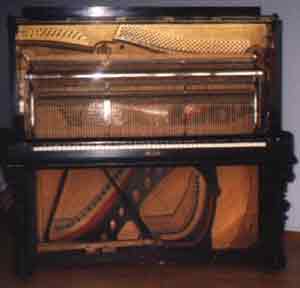
"Make sure there are no cracks in the soundboard", is mis-advice often given to piano buyers. This should better read, "...no cracks in the pin block". The soundboard can serve its special function with any number of cracks. The string passes its vibration through the bridge to the soundboard. The soundboard acts like a hgh fidelity amplifier. Mostly the sound you hear when you play the piano is the sound of the soundboard vibrating, not the strings themselves. In this, the piano operates exactly the same as the violin, guitar and all string instruments. Have you ever heard an electric guitar that was not plugged in? With no amplifier (or soundboard), strings make very little sound. The piano soundboard is a sheet of wood about 1/4 inch thick. It is crowned toward the strings, so that there is a downbearing pressure from the strings on the bridges. The highest quality boards are of close grained spruce or mahoganey. Some are laminated to prevent cracking or warping. You can tell when an older piano loses the crown of the soundboard, as it will have a longer after-ring that cannot be stopped with the dampers. Certain cracks associated with the soundboard can cause trouble. If the soundboard is separated fron the rim, it will vibrate. If the cracks separate the board from the ribs, it will rattle. If the cracks separate the board from the bridge, "dead" spots will occur in the tone of certain notes of the scale. These dead tones can be individual, or affect an entire section. Many modern pianos have soundboards consisting of threee laminations designed to never crack, split or warp. However, these laminatins have been known to separate, causing a very annouying buzz. All these conditions are repairable. Some require only a little first aid. Others are major. If you hear annoying rattles or buzzes that do not stop when you take the lamp off the piano, call the tuner for an evaluation. |
 |
 |
Many times I have heard people tell me that the last tuner "would not raise the pitch because the strings might break". Most often I then did the pitch raise without problem. String breakage is no more serious on a piano than on any other string instrument. If a string breaks, we simply replace it or repair it. String breakage becomes serious only when a large number of strings break in any section of the piano. For example, strings may break is a certain section of the bass only, or just of a certain section of the treble. Sometimes it is strings of all the same gauge. In many of these cases, the solution is a relatively inexpensive replacement of the poor section. Complete restringing is usually indicated when the strings break and the pins are also loose.
Proper functioning of the piano depends on the coordination of almost fifty different action parts for each of the eighty-eight notes, including the keys, hammers, dampers, etc. Among the thousands of parts involved, there are almost one thousand friction points. Each part, moving or static, must be adjusted to match the others. "Action regulating" is a process that includes repairing, renewing, and bringing each of these into a tolerance of one thousandth of an inch for the purpose of providing the player with consistent, controlled "touch". Some manufacturers suggest that although a concert instrument is regulated for every performance, a home piano that gets normal use should have the action regulated every two or three years. Some researchers suggest that over ninety percent of the pianos never receive this type of care, resulting in the touch being one of the most frustrating factors in piano playing. Tuning is also a struggle when the action is not regulated. |
|
Some tuners will struggle with "first aid" adjustments of parts that do not work, feeling that a customer might balk at the suggestion of an expensive regulation job. The twenty or thirty steps that must be done for each key can take eight ot twelve hours of concetrated effort charged at an hourly rate. A piano that is regulated every few years, however, may require much less time to maintain excellent touch. To give an idea of the complexity of the process, note the steps from a checklist for regulating a vertical piano: Remove action, tighten all screws, reshape hammers, clean piano and action, make necessary repairs, align and tighten regulation rail, align damper lift rod, travel hammers, space hammers to strings, space and square backchecks, space and square keys, set hammer stroke, regularte key capstans and key height, level white keys, then sharp keys, regulate hammer letoff, white key dip, hammer checking, sharp key dip, dampers to damper lift rod, sustaning pedal to damper lift rod, damper spoons, soft pedal, and bridle tapes. Piano players may notice the need for action regulation when the tone is not even from one note to the next, the overall touch is too light or too stiff, individual notes do not respond quickly or damp properly, or keys are sticking. Since each piano and piano player are different, setting the action to the "regulated" standards may not provide the desired results. For fine adjustments, the player may cooperate in the action regulation by playing the piano for a few days between each set of procedures by the technician. Many problems can be solved with patience, others may require a different piano! Voicing is an advanced procedure for adjusting the tone of a well regulated and tuned piano. it involves additional string to hammer regulating, hardening hammers by removing layers of felt or by chemicals, or softening hammers by carefully calculated and controlled jabs with needles, and even adjustments to the strings. The main object of voicing is finding a note with an acceptable tone, and adjusting the hammers and action of the other notes so the tone is even in all ranges of playing dynamics. Some piano players request that a technician try to "voice down" the overall bright tone of a piano, or to brighten a piano with dull tone. Sometimes these effects may be achieved by moving the piano to a different part of the room in order to change the relative position of walls, carpeting, or other physical features that affect room acoustics. In this series of photos, the technician checks the strike point, the hammer shape, and the felt density before needling the felt. |
|
 |
Almost all piano exteriors are made of furniture quality veneered hardwoods. Many manufacturers use panels that have a pressboard core. More expensive pianos may be entirely of hardwoods, including the core of the finely veneered panels. The cabinet does not contribute to the sound of the piano, just the appearance. Builders provide a variety of furniture styles to meet the needs of interior decoration. Most manufacturers recommend that no wax or polish be used on the protective lacquer finish that protects the wood. Waxes can build up, and some polishes can actually tear down the chemicals in the finish. A dry or even a damp cloth is all that will be usually needed to care for both the finish of the cabinet and the keytops. Many people use a commercial scratch cover for first aid of nicks and scratches. These products may make the job of the refinisher more difficult if you later decide to have a professional touch up job. "Touch up" is a difficult fine art practiced by some refinishers. |
 |
Refinishing a piano is a time consuming process of stripping and respraying that costs many hundreds of dollars. Be sure that your refinisher has eperience with pianos. If you decide to refinsh a piano yourself, consult with your tuner for advice on which parts of the piano should be dissassembled. Novices have been known to just paint over everything, sometimes painting shut the very panels that have to be opened for tuning. Piano benches do not last as long as pianos. Common repairs include tightening leg bolts, replacing hinge screws and lid props, repairing bottoms damaged by too many books, and touching up gouges and scratches. Bear in mind that it may be less trouble to order a new bench than sit on a dangerous one. Cabinet interiors are not accessible to piano owners, but they are easily invaded by dust, pencils, pennies, and a myriad of interesting small objects. These objects can slow or even stop a key from working. In addition to having your piano tuned, it is wise to establish an interval with your tuner for periodic cleaning of the interior. This may vary from a few to many years, depending on conditions in your area. Do not attempt to remove actions to retrieve objects. It is cheaper to pay a tuner to clean your piano than to repair broken hammershanks or twisted return springs caused by an over-enthusiastic do-it-yourselfer. |
 |
|
"Only two men? The last time we moved this monster, my husband had six of his biggest friends help!" The truth is, that is exactly why she called the movers this time. More damage is caused to pianos by well intentioned musclemen than anything else. If you are ever tempted to try the job on your own, follow this checklist: 1. Protecting the woodwork. Wrap the piano to protect the edges from bumping against doorways and walls. Cover the soundboard (the back) to reduce the rate of heat loss and gain, and to protect from humidity. Don't get it wet or hot. 2. Securing loose parts. Many older pianos have parts missing that were intended to hold a lid, key cover or kick board in place. Be sure that nothing is going to fall off. 3. Setting on the dolly. The best policy in lifting is, never lift both ends of the piano at once. One mover pulls down on the end while the other lifts the opposite end. The same procedure makes lifting into a truck or onto a stairway easy. 4. Securing to the truck. Too many major repairs are due to pianos falling out of trucks. Do not assume, just because the piano seems large and bulky, that it is stable. The piano is not well balanced. It will tip very easily. Tie it down so that it cannot tip or slide in any direction. |
 |
 |
5. Protecting enroute. Wrap it. Don't let the breezes blow on it. Keep it dry. Jarring may cause a piano with loose pins to become untuned. The piano has many thousands of delicate parts that can be easily broken. Be careful. 6. Moving in. Avoid heater and air vents, sunlight, and drafts when considering where to place the piano in the home. Consider the need for humidity controls in the piano if the new location is much drier or more humid than the last. 7. Selecting a tuner. Follow the recommendation of a reputable dealer or teacher. If such advise is not available, consider a tuner who has been certified reliable by the Piano Technician's Guild. Tune after wiaint two to four weeks for the piano to adjust to its new environment. 8. Cabinet repairs. If needed, call a refinishing shop and inquire about an expert in "touch-up". Not all refinishers have this special skill. 9. Action, string and soundboard repairs. Ask the tuner before he comes if he is equipped for such repairs. Not all tuners are technicians, not all technicians are rebuilders. 10. Your next move. Now you are experienced and probably know how much a mover can help. Be sure that you ask if the mover is experienced and equipped for piano moving. Ask your tuner's advice at each end of the move. |
| The piano is an exciting musical instrument, a valuable music education tool. The tuner shares part of the great and important responsibility to encourage the students' progress along with teachers, parents, and dealers. This responsibility includes giving them proper advice in the care and keeping of the piano. Maybe pianos in heaven won't need as much care as those here, but many of our pianos could sound much more heavenly with proper care. |  |
|
 go to Howard Piano Service go to Howard Piano Service
|
|
 "I
don't understand why the piano is out of tune already. You just
tuned it a few years ago!"
"I
don't understand why the piano is out of tune already. You just
tuned it a few years ago!"