 The Future of the PianoThe Future of the Piano
a suite for everyone by Roy E. Howard
Bartolomeo Cristofori visits Kansas
Back to the Future Suite score sound | audience flute clarinet piano violin 1 violin 2 viola cello
Lost Things score sound | piano 1 sound | piano 2 sound | piano 3 sound |
Where do things go when they fade away?
Where is the end of eternity?
Where is there a man who can stand and say
that he found the place where lost things go?
In all of history the things we make all change with changes in the technology.
But who will stand with me and say that the piano is here to stay!
The "Back to the Future" Festival puts pianos and piano playing in a historical context to help us all work toward a future WITH pianos. That is the key question: IS there a future for the piano? There is no future if people stop playing the piano because they satisfy their needs for music some other way. Every home in all the world has music, but very few have a piano. We have to work hard to foster more than appreciation for the piano. The next generation must cherish it as we do, or it will go the way of the harpsichord, reed organ, Edsel, and Saturn.
There are many aspects to our job of fostering these values. We must start to identify them, and see if there are any that we have the power to address. For example, maybe we can't fix how changes in the world economy has caused a shift in piano production to other countries; but we can encourage our community to attend and support arts events that use pianos; schools, churches, and other institutions to have and use them; promote events that bring friends together around the piano; and encourage families to use the piano to interact with each other and build memories. We must be very good marketers in competition with many distractions to everyone's time and resources. If we are successful, pianos will continue to have a role in families and communities for generations to come. Our main job is not to produce a few elite performers and a cadre of consumers. We must help everyone want to have a piano and play it. That will only happen if the piano meets their needs, especially the need for social interaction.
The future of the piano could be tenuous. There are many distractions and options to take the time of the children. Any technology, tool, or concept will survive only as it adapts to changing conditions. So how does piano playing adapt? One way is to acquire new technology such as computerized keyboards, but how can acoustic pianos and piano playing adapt? Not only using that instrument to play each new genre that comes along in popular music but also by playing the music of every nation. The future seems to be a shrinking world in which our economy depends on the well being of China and India and everywhere else. Each nation is full of people migrating from every other nation. We may be able to to have a future for the piano if we use it to make connections to the long tradition and culture and history of each of these cultures. Maybe that is how there can be a future for the piano: if we can foster in our citizenry a love for the multicultural piano.
Let's keep everyone thinking about what it means for the piano to have a future. This composition promotes participation by everyone, and thus gives hope that pianos will be continued to be played in the future.
The main theme is a Roy E. Howard orignial "Lost Things", which is a call to everyone to rescue the piano. The other musical themes are historical, traditional folk tunes of various nations that bring families and friends together. The first recognizable tune is "Happy Birthday to You". The audience consists of music students and teachers who will have to read the music and then clap, stomp, hit their chair, or do whatever the music says. The piano is currently being used in every nation for every type of music. Can we keep that trend going?
"I immediately feel vibrations that thrill my whole being. These are the Spirit illuminating the soul power within, and in this exalted state, I see clearly what is obscure in my ordinary moods: Then I feel capable of drawing inspiration from above, as Beethoven did ... Straitway the ideas flow in upon me, directly from God, and not only do I see distinct themes in my mind's eye but they are clothed in the right forms, harmonies and orchestration. Measure by measure, the finished product is revealed to me when I am in those rare, inspired moods.
The powers from which all truly great composers like Mozart, Schubert, Bach and Beethoven drew their inspiration is the same power that enabled Jesus to work his miracles. It is the power that created our earth and the whole universe."
~Johannes Brahms
from "Talks with Great Composers" by Arthur M. Abell, published by Philosophical Library
THE FUTURE OF THE PIANO
Music IS a Universal Language
Music is called the universal language of the world because of many reasons. First and the foremost, music is made up of 7 main notes. No matter, what part of the world you are, and what instrument you play, all the music created are one of the 7 notes. There may be different names for all 7 notes in different parts of the world, but for the performer, they are still the same. Secondly music, being a form of art can reach the deepest parts of your heart and soul. You don’t have to be a patient or a psychologist to understand music. As long as any melody and rhythm make you feel yourself, it is the best doctor a person can find, and best remedy anyone can recommend. Thirdly music, like any other language can express any and every type of emotion. But where it scores more is where the words fell short of expressing, while music can go on and on vocalizing all that you ever want to say. (Sapan Shah, Buzzle.com)
Music is NOT a Universal Language
Music would be a universal language if everyone in the world could to interpret the same music in the same way. However, appreciation of music, painting, poetry, sculpture and other arts depends on cultural understanding and experiences that are unique to communities, age groups, and individuals. These understandings are very particular and discrete. People don't even like the same music. For example, as an ethnomusicologist, I studied the Mexican heritage musicians of Texas and New Mexico. They are all very particular about their own style, not crossing over to other Mexican or Mexican American styles http://www.cantos.org/music/mexico.html . The Pan-Indian movement in North America has resulted in new types of Pow Wow music appreciated by all the Pow Wow fans, but I don't hear any of that on any station in Kansas. Everyone is very selective about music, but most don't understand how diverse the musics of the world are. Google "how many types of music" and you get 24,000,000 hits, meaning everyone has an opinion on the subject. In the first ten hits, there are more than 10 different (authoritative sounding) answers ranging from "There are four main categories of music: rock, jazz, blues, and classical", to "there are a million different types of music". Louis Armstrong claimed: "There is two kinds of music, the good and bad. I play the good kind." Mark Twain "was told that music by Wagner is not as bad as it sounds". It is clear that not everyone understands the same music in the same way.
Music is a Universal Phenomenon
Plato said that "music gives a soul to the universe, wings to the mind, flight to the imagination, and life to everything." Everyone has music in their life, but as a musician, I have been painfully aware that not everyone will buy what I sell. People are very particular about the music they listen to. There are 44,000 different radio stations in the world. Most focus on a very narrow range of music. Any deviation from the expected programming will lose listeners. Check this site, and you will certainly find a station that you would not want to listen to all day: http://www.omniglot.com/links/radio.htm
Webster defines language as "any means of conveying or communicating ideas". Music cannot convey the same idea to people of any society or culture. "Music as a universal language" advocates give examples of folks appreciating music of another culture, but no one really understands another culture's music in the same way. Personal expectations and assumptions influence how music is perceived. "Music is a universal phenomenon" would be more accurate than saying that music is a "universal language".
The Piano as a Universal Instrument
The "King of Instruments" has survived several centuries of cultural and economic and political change. It is played in every continent, in every style of music. However, we need to be vigilant if we want it to survive. Yesterday I stepped into a "piano store" and saw dozens of keyboard instruments with nice cabinets, but only three acoustic pianos. They were on sale for up to 50% off, a sign that the dealer is not stocking up on pianos, just trying to get them off the floor and out the door.
That day I evaluated an old upright that can't be removed from the basement without calling a carpenter to remodel. They decided to keep the piano (though no one has every played it and it is a whole step flat). I will install new casters so they can move it around. The senior centers and care facilities have pianos, but few of the seniors know how to play them. Churches and schools are replacing pianos with electronic keyboards.
I tuned a piano for a full time professional piano player. He accompanies the school choir, plays in restaurants, teaches, etc. He has never owned an acoustic piano. He just bought his first home and moved his parents old console into it. His students mostly play electronic keyboards. Not even the full time piano professionals buy pianos! The piano can be used in more styles and types of music than any other instrument, but not everyone buys a new piano.
I told the receptionist, "if you want me to pay $300 for my wife's dental work, please buy a piano, so I can afford it". She said that she wants her daughter to have lessons but does not have room for a piano, that she might get a keyboard. I said, "that is like telling everyone that they don't need real teeth. If we replace all the teeth with plastic, then we don't need dentists, and no one will have pains or have to floss or anything." She did not like the analogy, but what is the differenee? Replace pianos with keyboards? What is the world coming to?
WHAT TO DO?
So what can we as technicians, dealers, and teachers do to reverse the further decline of the piano? Carl Radford, RPT, North Shore Chapter, gives good advice:
•Leave the piano well tuned, voiced and regulated so that the customer will be pleased with the tone and touch and therefore want to play. •Demonstrate the piano after the tuning for the customer so the they will be inspired enough to desire to play the piano themselves.
•Tune Well Temperament and use it, when appropriate, to resurrect the color in Classical and Romantic music.
•Work on high quality pianos and your referral base will also be of high quality. Less is more.
•Sell the best pianos possible, educate the customer and change the focus from sales at all costs to quality and inspiration of the customer at all costs.
•Make sure your students understand the value of a quality piano, a proper tuning, voicing, and regulation.
•Don't allow students to purchase poor quality pianos, and educate them to recognize the difference.
•Make sure their piano is in a different room from their TV. http://www.radfordpiano.com/future.html
Everyone claims to like music, but there is yet much we must do to educate people so their musical participation can grow. "Men profess to be lovers of music, but for the most part they give no evidence in their opinions and lives that they have heard it" (Henry David Thoreau).
Music is not a "universal language" nor any type of language. "Music expresses feeling and thought, without language; it was below and before speech, and it is above and beyond all words" (Robert G. Ingersoll). 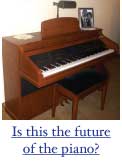
Music is a part of every life. The piano is certainly the "King of Instruments", and a very fine way that people of all cultures and musical traditions can find expression to their deepest feelings.
Let's do all we can to promote and encourage piano playing in the homes and schools and churches. Let us support and encourage the use of pianos in performances and recordings and new compositions.
"Music is a higher revelation than all wisdom and philosphy. Music is the electrical soil in which the spirit lives, thinks and invents" (Ludwig van Beethoven).
1927, Cable Piano Company
"Every child in our country should learn how to sing, and how to play upon at least on musical instrument. Among these the piano is perhaps the most practical for musical cultural purposes. Nothing should crowd out the opportunity for self-expression which can come to those who can play the piano with some degree of mastery" (Walter Damrosch)
Probably no one is better qualified than Walter Damrosch to say just what part the piano should play in the life of every child. Forty-two years experience as conductor of the New York Symphony Orchestra gives him the unquestioned right to say that the piano is the most practical of all instruments for musical cultural purposes.
Walter Damrosch knows that the ability to play the piano brings an infinite pleasure both to those who play and those who listen. For the piano is the basic musical instrument - the foundation of all music.
The new methods of teaching have made learning to play the piano simpler than ever before. This new process of Group Piano Instruction is a source of interest and pleasure because it carries the children into the actual playing of melodies from the start.
The piano, under progressive American development, has reached virtual perfection in beauty of design and in enduring soundness of construction. This tremendous industry producing the greatest of all musical instruments - the piano - has recently assumed an obligation to enable every child in America to have a piano education.
Pianos are designed to suit every possible need from the concert platform to the modest home, in a wide range of designs and at varying prices - grand pianos, upright pianos, marvelous reproducing pianos that bring the great artists to your home and player-pianos that can give you a world of enjoyment while your children are learning to play.
This 1927 promotional is by the Cable Piano Company, one of those who went out of business 2 years later with the stock market crash! Changes can come fast. Last year Saturn was advertised as the "car of the future". Could their demise portend the future of the American auto industry? The American piano industry already did collapse. I think we should be in crisis mode, working hard to revive piano playing by everyone in America.
Go to Piano History | Go to Piano Selection | Go to Piano Care | The Future of the Piano