Presented by Dr.
Roy E. Howard, Western New Mexico University Gallup Graduate
Studies Center
Information about Diciembre Mundial by
Cantos Para Todos
Presented by Dr. Roy E. Howard, Western
New Mexico University, Gallup Graduate Studies Center
Holiday Traditions
People all over the world celebrate the winter season with special
events. Thanksgiving, Hanukah (November 28),
Christmas, and New Year's Day are joined by Advent (November
27), St. Andrew's Day (November 30), St.
Nicholas Day (December 6), Human Rights
Day (December 10), La Virgen de Guadalupe
(December 12), Santa Lucia Day December
13), Bill of Rights Day (December 15),
and many others as days for remembering our traditions, our families
and community, and for giving gratitude for another good year
of life.
December Traditions
In the northern countries, particularly those with the
harshest and earliest winters, the richest December traditions
have evolved, perhaps as a response to the darkness, the cold
and the isolation. We celebrate as long and as often as we can
with family gatherings, bright lights, and cheerful colors. The
austerity of the time leads us to remember the needy with special
acts of service, and gifts. En Diciembre celebrates this
universal feeling that December is special.
La Piñata
The clay pot decorated with 7 points represents the seven
cardinal sins. The blind folded child with the stick represents
mankind's efforts to overcome evil. The breaking of the pot represents
victory. The gathering of the candy, fruit and gifts that fall
from the pot represent the celebration of good. Baile de Piñata
and Echen Confites celebrate the fun of the party.
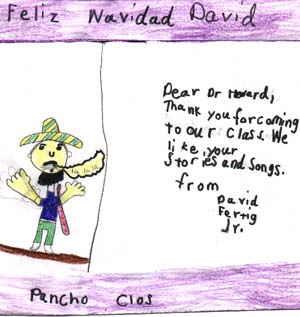
Pancho Clos
As an alternative to the commercialism of Santa Claus,
Pancho Clos has evolved in some communities as a black bearded
man wearing a sarape, riding a cart pulled by burros. The South
Pole cousin of Santa, he does not bring gifts other than candy,
instead he helps the children do things for others, as exemplified
in Oye Primo Pancho Clos. Also, with his burros, he can
go places that Santa Claus cannot go, as in ¡Ajúa,
Ajúa!
Song Words
Article about the presentations
| Teacher Development in ESL Indian
Education | September
| October | November
| | November | December
| January -February | March
-M ay |
Presented by Dr.
Roy E. Howard, Western New Mexico University Gallup Graduate
Studies Center